
Escalation · 12:19
A Client Criticized You in Front of Your Team: Tell Your Boss?
Published October 13, 2026
 A Client Criticized You in Front of Your Team: Tell Your Boss?Watch on YouTube, 12:19Oct 13, 2026VideoScriptPractice sheet
Know Exactly What to Say
The full script is below, word for word, for when a problem has to go to someone more senior. Copy it, change the names and dates, and it is ready to send or say.
Practice It Before the Real Conversation
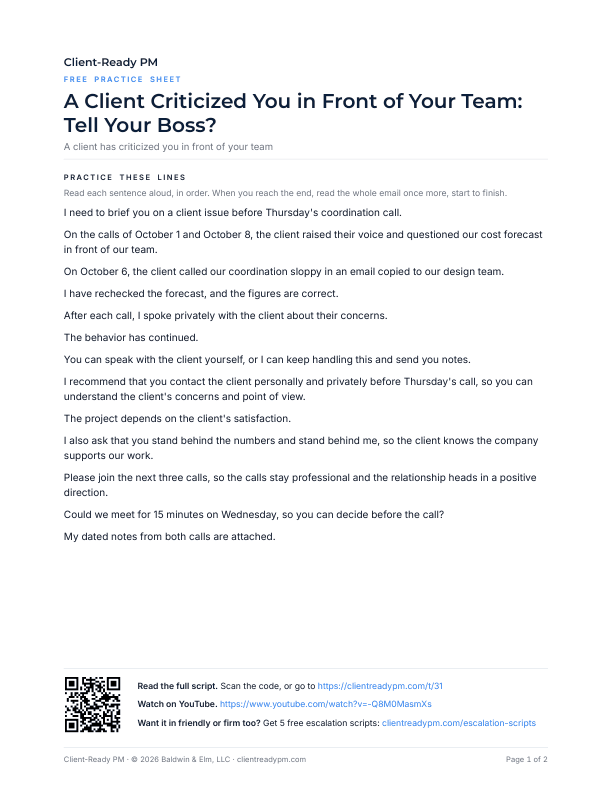
A printable PDF. Say the lines out loud, then fill in your own project's names and dates, so the words are yours before the client is on the line.
Download the practice sheet (PDF)How to Use a Script
Four steps:
- Watch the video once.
- Copy the script. Change the names, dates, and numbers to match your project.
- Say it out loud until it sounds like you. Use the practice sheet if the page has one.
- Use it in the real conversation, in the email or on the call.
The Script
Word for word, as said in the video. Copy it and change the names, dates, and numbers to match your project.
ScriptA Client Criticized You in Front of Your Team: Tell Your Boss?
Two days before that, the client called your coordination sloppy in an email copied to your design team. You lead the weekly coordination calls on a mixed-use retail project. Your team heard both calls, and your design team read the email. After each call, you spoke with the client privately, and nothing changed. Now you're deciding whether to tell your manager.
Tell your manager now. What's at stake is the project, and a project succeeds when the client is satisfied. Right now the calls are working against that. You tried to resolve this privately with the client first, and that was the right first step. Now a second person can help. If you keep managing it alone, your manager may hear it first from the client or your design team, with no time to prepare. Telling your manager isn't the same as asking your manager to fix the client. You keep ownership of the project. Your manager helps you repair the client relationship. It also protects your reputation, because your manager hears it from you first. You'll send one short email, with dates and clear asks.
The groundwork is done. The two calls have dated notes. The forecast was rechecked, and the figures are correct. After each call, you spoke with the client privately about their concerns. You also asked the client to send cost questions to you before each call. The behavior continued. So the open question is what your manager can do that you can't.
Remember to get the five free escalation scripts. The link is in the description.
The email is built from four pieces. Facts. Options. Recommendation. Next step.
Facts. On the calls of October 1 and October 8, the client raised their voice and questioned our cost forecast in front of our team. Each call has its date. You describe what the client did, and you leave their character out. And there is no word about how the calls felt. Your manager can check a date. A feeling can't be checked. The next sentence adds the email, with its date. The sentences after that show you have acted. The forecast is checked, and you have spoken with the client privately. Then you say the behavior has continued. Another way to put it, at our calls on October 1 and October 8, the client questioned our forecast in front of the team. Or, the client raised their voice on two calls, October 1 and October 8.
Now say it with me. Slow.
Again, normal speed.
Options. You can speak with the client yourself, or I can keep handling this and send you notes.
Now say it with me. Slow.
Again, normal speed.
Recommendation. I recommend that you contact the client personally and privately before Thursday's call, so you can understand the client's concerns and point of view. Begin with I recommend, and put the reason in that same sentence. Then come the two other asks. Your manager stands behind the numbers and behind you, and joins the next three calls. Look at the sequence. Your manager reaches out privately, before the call, so the client is never surprised in a meeting. The other option has a cost too. If you handle it alone, the client's concerns may stay unresolved, and your manager hears about a 3 incident like this after your design team does. The reasons are about the project and the relationship, not the client's character. Another way to put it, my recommendation is that you reach out to the client before Thursday. Or, it could help if you spoke with the client first.
Now say it with me. Slow.
Again, normal speed.
Next step. Could we meet for 15 minutes on Wednesday, so you can decide before the call? Wednesday comes with its reason. Your manager can decide and reach the client before Thursday's call, and you both go in prepared. 15 minutes is easy for a manager to give. Another way to put it, do you have 15 minutes on Wednesday, so you can decide before the call? Or, could we talk on Wednesday, before Thursday's call?
The last sentence attaches your dated notes. After Thursday, keep writing in the same notes, so the log shows how the next three calls go.
Now say it with me. Slow.
Again, normal speed.
More Escalation Videos
 Telling Your Manager About a Client Problem? Facts, Not FeelingsWatch on YouTube, 0:15Nov 18, 2026
 Client Yelled on a Call Again? Tell Your ManagerWatch on YouTube, 0:55Nov 4, 2026
 A Client Says Your Team Is Always Late: Friendly, Neutral, or FirmWatch on YouTube, 2:13Oct 30, 2026
 Difficult Client? Which Email Gets Your Manager's Support?Watch on YouTube, 2:24Oct 17, 2026
 Don't Vent to Your Manager About a Difficult ClientWatch on YouTube, 1:18Oct 13, 2026
 Tell Your Manager About a Difficult Client: Friendly, Neutral, or FirmWatch on YouTube, 2:06Oct 12, 2026
 A Client Raised Their Voice Twice: What You Tell Your ManagerWatch on YouTube, 1:19Oct 11, 2026
 Stuck on an Approval for 3 Weeks: The Escalation Message to SendWatch on YouTube, 0:48Sep 26, 2026
Free script pack
Get the Free Escalation Script Pack
The next conversation will not sound like this one. The free Escalation pack gives you five more scripts for when a problem has to go to someone more senior, each in friendly, neutral, and firm versions, so the right words are ready before you need them.
The pack arrives by email in a few minutes. After that, the weekly newsletter.
Your address is used only for the pack and the newsletter. No spam. Unsubscribe anytime.