
Pushback · 12:00
Saying No to a Client: The Exact Words That Keep It Professional
Published September 25, 2026
 Saying No to a Client: The Exact Words That Keep It ProfessionalWatch on YouTube, 12:00Sep 25, 2026VideoScriptPractice sheet
Know Exactly What to Say
The full script is below, word for word, for when a client asks for something you cannot agree to. Copy it, change the names and dates, and it is ready to send or say.
Practice It Before the Real Conversation
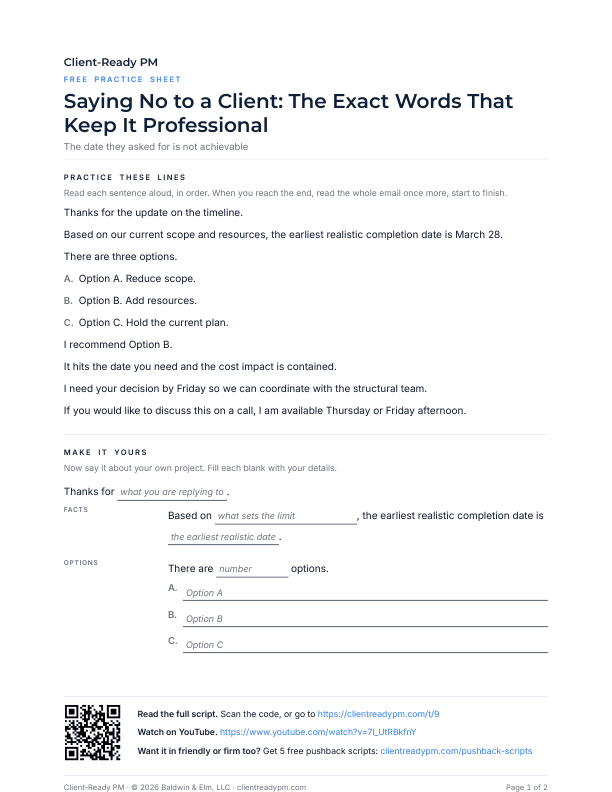
A printable PDF. Say the lines out loud, then fill in your own project's names and dates, so the words are yours before the client is on the line.
Download the practice sheet (PDF)How to Use a Script
Four steps:
- Watch the video once.
- Copy the script. Change the names, dates, and numbers to match your project.
- Say it out loud until it sounds like you. Use the practice sheet if the page has one.
- Use it in the real conversation, in the email or on the call.
The Script
Word for word, as said in the video. Copy it and change the names, dates, and numbers to match your project.
ScriptSaying No to a Client: The Exact Words That Keep It Professional
This video gives you the exact structure, the exact words, and the exact tone so you deliver that message in client-ready English, with full control, zero defensiveness, and a clear path forward. By the end, you will have a structure you can use in your next client email or call today.
A client requests an unrealistic deadline. A client keeps adding tasks outside the original scope. A client wants to skip testing. A client disagrees with your technical recommendation. A client escalates with a complaint email cc'd to leadership. Now you have to hold your position without damaging the relationship.
Your brain goes into protection mode. You start planning how to defend yourself. How to prove you were right. How to make sure everyone knows the client made the bad call. That instinct is normal. But it works against you. When you focus on being right, the client stops listening to your plan. They start wondering if you actually care about their success or just your own reputation.
The client cares about three things. What is the real constraint. What are the options that work within that constraint. What do you recommend. That is what we are going to cover.
The structure for a pushback message has four parts. Facts. Options. Recommendation. Next step.
Facts. State what is true and what the constraint is. No blame. No defensiveness. Just the reality.
Options. Show the client what choices actually exist within the constraint. These are not fake options designed to trick them into the outcome you want. They are real choices with real trade-offs.
Recommendation. Tell them which option you think is best and why. You are the expert they hired. They expect your professional judgment.
Next step. Ask for a decision or confirm what happens next. Do not leave it open.
Facts. Options. Recommendation. Next step. We use this structure across every difficult conversation in project management. It works because it is clear, professional, and it shows the client you are thinking about their success, not just your own protection.
Before we get into what to say, let me walk you through five mistakes that cost PMs credibility when they push back. Number one. Do not focus on what you will not do. If all you say is, we cannot skip testing or that deadline is not realistic, the client hears no and stops listening. Your job is to show them what actually works.
Number two. Do not make it about winning the argument. Even if you are right and the client is wrong, if the client feels attacked, they go defensive. And then their leadership gets involved. State the fact. Defend the position. Then pivot to options.
Number three. Do not offer fake options. Options like, we can either do it right, or we can do it wrong, are not options. They are you disguising your preferred answer as a choice. Give them real trade-offs. Less scope, more time, more budget.
Number four. Do not use vague language. We need time for quality, or the deadline is a stretch, tells the client nothing. How much time? What is the new date? What does it affect if we proceed anyway? Be specific.
Number five. Do not over-explain or get emotional. The client does not need to hear why you think they are being unreasonable. They need the impact and the path forward.
Now let's look at what you should say. I will break it down one section at a time. Start with the fact. You have a choice. You can pick your opening based on context. For an email or written update, you might say, update on the timeline, or thanks for the message. For a verbal update in a meeting or call, you might say, I want to flag something on the schedule. For a softer opening with a particularly sensitive client, you might say, wanted to bring something to your attention. Pick the one that matches your situation. All of them lead into the same structure.
Now the facts. Let's say the client has asked you to move a deadline up by two weeks. The fact is simple and clear. Based on our current scope and resources, the earliest realistic completion date is March 28. To hit the February deadline, we would need to reduce scope or add resources. Notice what is missing. No drama. No apology for reality. No explanation of why the client is being unreasonable. Just the fact, and the constraint.
Now the options. There are three options. Option A. Reduce scope, and deliver the core package by the February date with the remaining items to follow. Option B. Add resources, bring in a second reviewer, and hit March 14. Option C. Hold the current plan and deliver the complete package on March 28.
Notice that every one of those actually answers the constraint. You can open this a few ways. You could say, there are three options, or, I see three paths forward, or, we have three ways to handle this. You are showing the client the landscape. You are not dumping the problem on their desk.
Now the recommendation. I recommend Option B. It hits the date you need and the cost impact is contained. You could also say, my recommendation is Option B, or, Option B gives us the strongest path forward. You are making a professional judgment and backing it with reasoning. That is what the client expects.
Now the next step. I need your decision by Friday so we can coordinate with the structural team. If you would like to discuss this on a call, I am available Thursday or Friday afternoon. You could also frame it as, can you confirm your direction by Friday, or, we need alignment on this by Friday to hold the schedule.
THAT is how you push back professionally. No defensiveness. No drama. Facts. Options. Recommendation. Next step.
Each button opens the video at that round, slow, normal business pace, or full business speed. The line is the same every time; only the pace changes.
- Based on our current scope and resources, the earliest realistic completion date is March 28.
- There are three options.
- Option A.
- Reduce scope.
- Option B.
- Add resources.
- Option C.
- Hold the current plan.
- I recommend Option B.
- It hits the date you need, and the cost impact is contained.
- I need your decision by Friday, so we can coordinate with the structural team.
- If you would like to discuss this on a call, I am available Thursday or Friday afternoon.
Free script pack
Get the Free Pushback Script Pack
The next conversation will not sound like this one. The free Pushback pack gives you five more scripts for when a client asks for something you cannot agree to, each in friendly, neutral, and firm versions, so the right words are ready before you need them.
The pack arrives by email in a few minutes. After that, the weekly newsletter.
Your address is used only for the pack and the newsletter. No spam. Unsubscribe anytime.